If you run a dance school, gymnastics club, swim school, football academy or martial arts programme, you already know the frustration: a child is booked into a class, the spot is held, and then... nobody shows up. No call, no message, just an empty space on the mat, in the pool lane, or on the pitch.
No-shows aren't just annoying. They quietly cost activity businesses thousands of pounds a year, disrupt group dynamics, and make it harder to run a waiting list fairly. The good news is that no-shows are rarely random — they follow predictable patterns, and most of those patterns can be fixed with the right systems.
This guide breaks down why no-shows happen, what they actually cost your business, and 12 proven strategies you can start using this term.
Why No-Shows Happen
Before fixing the problem, it helps to understand the root causes. In our experience working with dance schools, gymnastics clubs, swim schools and football academies, no-shows usually come down to a handful of recurring reasons:
- Forgetfulness — parents are juggling multiple children, multiple activities, and multiple calendars. A Tuesday 4:30pm ballet class is easy to lose track of.
- No easy way to cancel — if cancelling requires a phone call during business hours, many parents simply won't bother, and the child just doesn't turn up.
- Unclear policies — parents don't know whether they'll be charged for missing a session, so there's no incentive to notify you.
- Low commitment from "free trial" or casual bookings — a class that cost nothing to book carries little obligation to attend.
- Illness or last-minute changes — genuinely unavoidable, but still leave a gap that could often be filled by a waiting list.
- Overbooked family schedules — clashes with school events, other siblings' activities, or family commitments that weren't anticipated when the term was booked.
Most of these causes have one thing in common: they're communication and systems failures, not a reflection of how much families value your classes.
The Hidden Cost of Missed Bookings
No-shows are easy to underestimate because the damage is spread thin across a term. But run the numbers and it adds up fast.
Say a gymnastics club runs 20 classes a week, each with 12 spots, at £8 per session. A modest 10% no-show rate means roughly 24 empty spots a week — that's £192 a week, or nearly £8,000 across a 40-week year, in lost or unrecoverable revenue and unfilled capacity.
Beyond the direct financial hit, no-shows create knock-on costs:
- Wasted staff time — coaches and instructors preparing and running sessions for children who never arrive.
- Blocked capacity — a "full" class that's actually half empty means other families on the waiting list miss out on a spot they'd have used.
- Poor group experience — inconsistent attendance disrupts progression, partner work, and team dynamics, especially in dance, gymnastics and football.
- Admin overhead — chasing payments, rearranging groups, and manually managing waiting lists all take time your team could spend elsewhere.
Once you see no-shows as a recurring revenue leak rather than an occasional inconvenience, it becomes much easier to justify investing time in prevention.
12 Proven Strategies to Reduce No-Shows
1. Send Automated Reminders
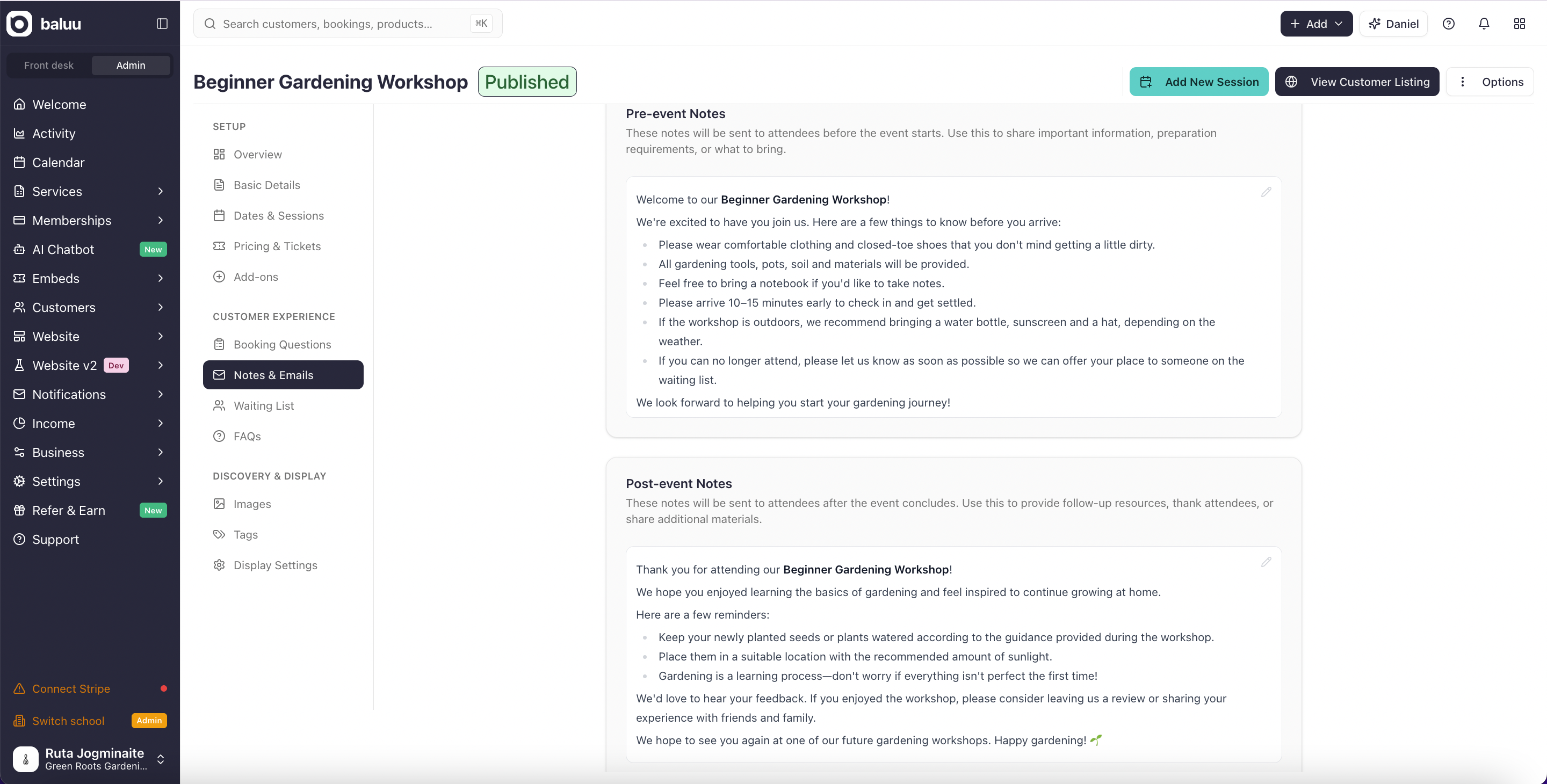
The single biggest lever for reducing no-shows is simply reminding people. Automated SMS and email reminders sent 24–48 hours before a session, and again a couple of hours beforehand, catch the busy parents who genuinely forgot. A local swim school that introduced automated reminders reported a noticeable drop in unexplained absences within the first month, simply because parents had a clear, timely nudge. Notes & Auto-Emails
2. Make Cancelling as Easy as Booking
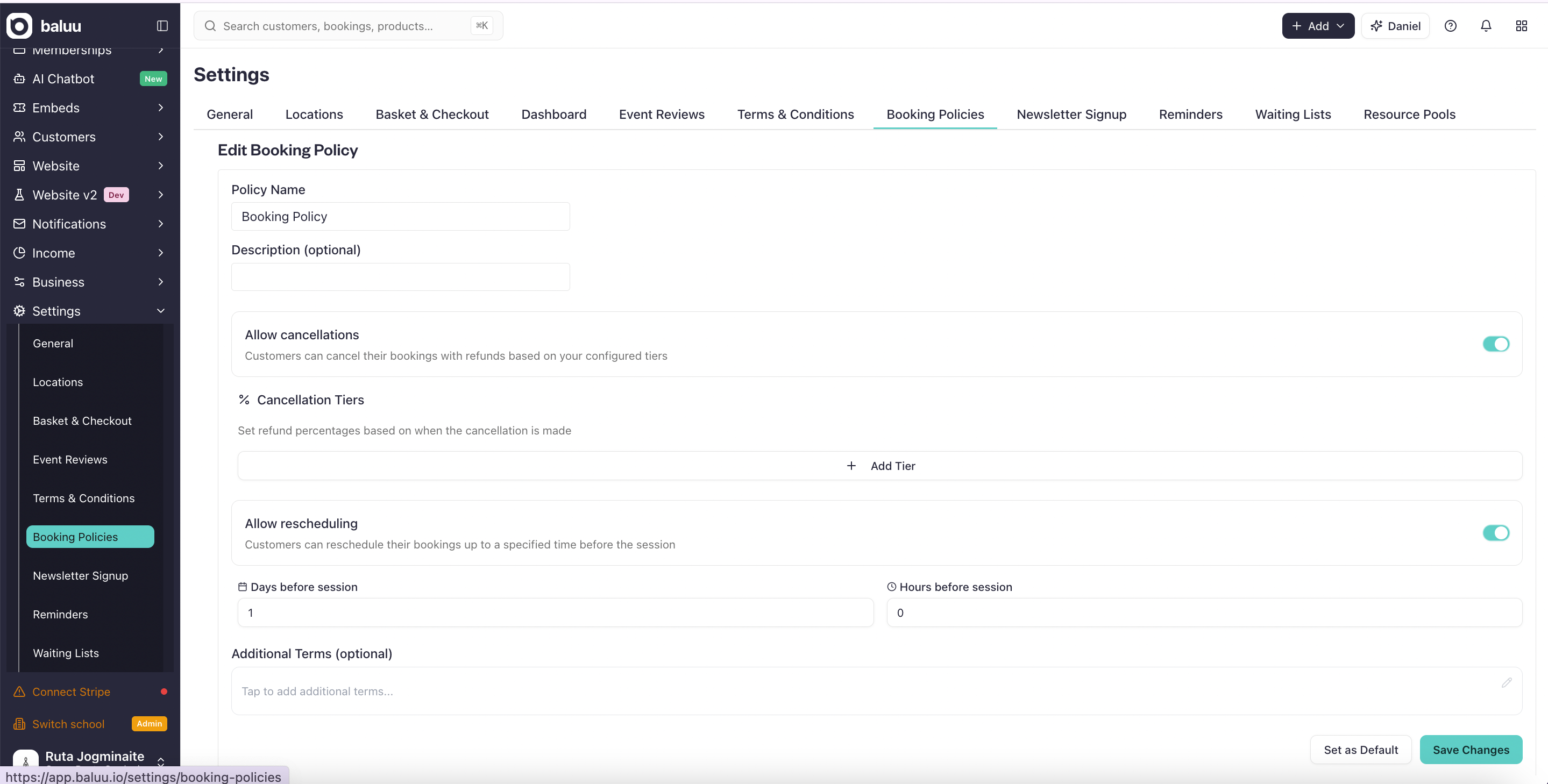
If cancelling a spot requires a phone call during office hours, most parents will do nothing and the child just won't show up. Give families a simple online way to cancel or reschedule, so at least you know a spot is free and can offer it to someone on the waiting list. How to add Booking Policies
3. Use a Waiting List — and Actually Use It
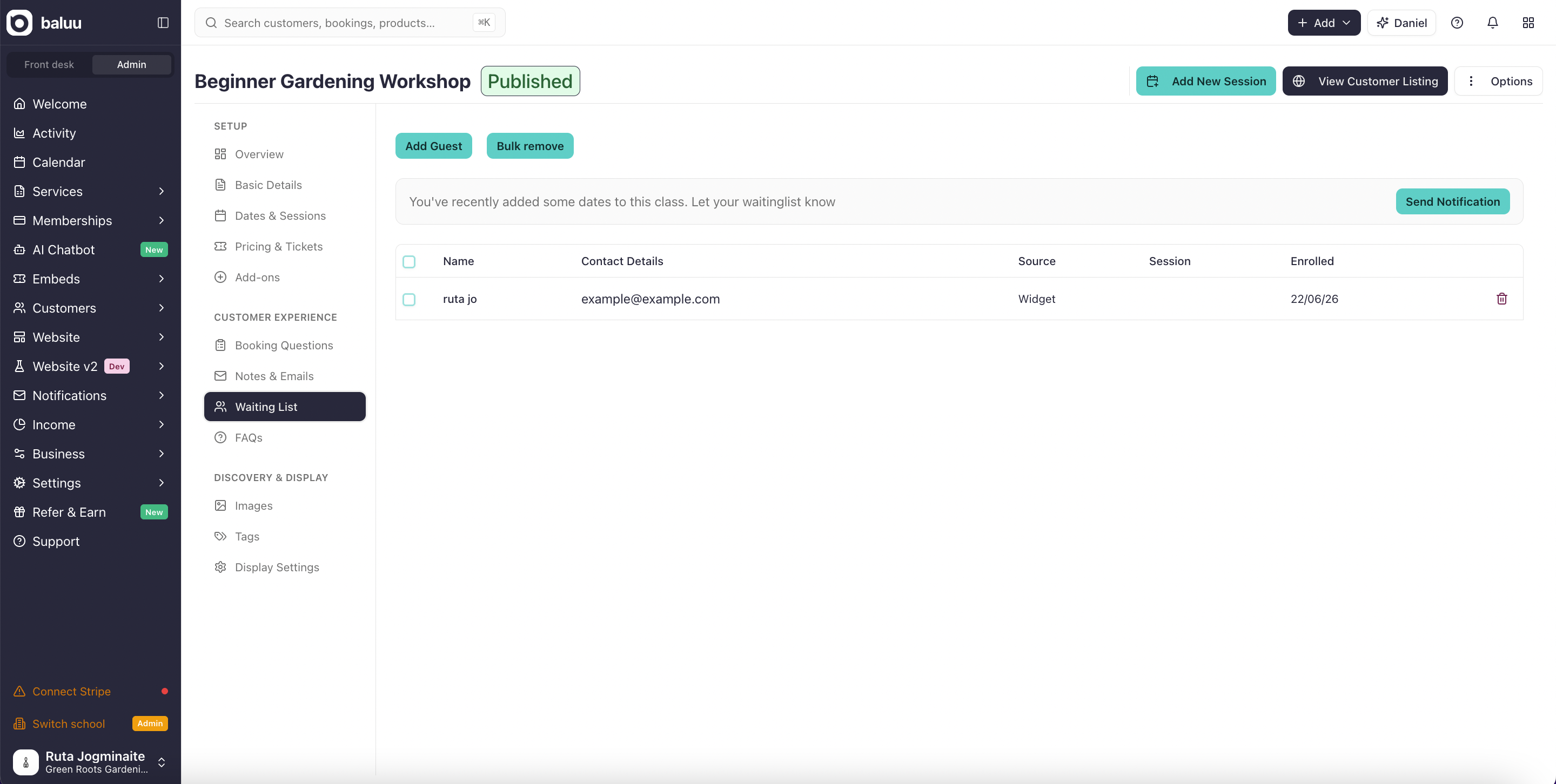
A well-managed waiting list turns a no-show into an opportunity rather than a loss. When a family cancels or fails to check in, the next person on the list should be automatically notified and given a fair chance to claim the spot. This is especially powerful for popular classes like after-school football or high-demand dance grades. How does the Waiting List feature work?
4. Take Payment Upfront
Free or "pay later" bookings carry very little commitment. Requiring payment — even a small deposit — at the time of booking significantly increases the likelihood a family will show up, because there's now a cost attached to not attending. Online payments also remove the awkwardness of chasing cash or cheques on the day. Accepting Payments with Baluu
5. Introduce a Clear Cancellation Policy
Set out, in plain language, how much notice is needed to cancel without charge, and what happens if a child doesn't show up. A martial arts club that introduced a simple "24-hour cancellation" policy — clearly stated at sign-up and reflected in every confirmation email — saw far fewer last-minute no-shows because parents understood the consequences upfront.
6. Confirm Bookings Immediately
Every booking should trigger an instant confirmation with the date, time, location and what to bring. This isn't just good customer service — it also gives parents a written record to check against, reducing the "I thought it was next week" excuses.
7. Offer Flexible Rescheduling
Life happens. If a child is ill or a family has a clash, allowing an easy, self-service reschedule to another class in the week (rather than losing the session entirely) reduces the temptation to simply not show up and say nothing. Flexible policies build goodwill and make families more likely to communicate rather than disappear.
8. Reduce Friction at Sign-Up
If registering for a term or a trial class involves paper forms, email chains, or multiple phone calls, some families will lose momentum and treat the eventual booking as low-priority. A smooth, mobile-friendly online booking process signals professionalism and increases the perceived value of the spot they've secured. How Customers Book with Baluu
9. Personalise Communication
A generic "Reminder: you have a class tomorrow" is easy to ignore. Messages that include the child's name, the coach's name, and specific details ("Emma's Under-8s football session with Coach James, 5pm at the Sports Hall") feel more real and harder to forget. Personalisation is one of the simplest ways to make automated messages feel less robotic. Notes & Auto-Emails
10. Track No-Show Patterns
Keep an eye on which families, classes, or time slots have the highest no-show rates. A dance school might find that late Friday afternoon classes have a much higher no-show rate than Saturday mornings — a sign to review scheduling, staffing, or even pricing for that slot. Data turns a vague frustration into a specific, solvable problem.
11. Reward Consistent Attendance
Positive reinforcement works alongside policy. Simple attendance streak rewards, certificates, or shout-outs for children who attend regularly can subtly shift the culture of a class toward reliability, particularly for younger children in gymnastics or swim schools where parents respond well to visible progress markers.
12. Make It Easy to Reach You
Sometimes a no-show happens because a parent tried to get in touch and couldn't. A visible, monitored communication channel — whether that's a booking platform message, WhatsApp, or email — means families can flag problems before the class starts, rather than staying silent.
How Automation Ties It All Together
Individually, each of these strategies helps. Together, they compound. A modern booking system can automatically send reminders, take payment at the point of booking, manage the waiting list, confirm cancellations, and log attendance patterns — without your front-desk team lifting a finger for each transaction.
This matters because manual admin doesn't scale. A small swim school with 40 pupils might manage reminders through personal phone calls. A football academy with 400 children across a dozen age groups simply can't. Automating the repetitive parts of communication and booking management frees your staff to focus on coaching and customer relationships, while consistently applying the policies that reduce no-shows.
No-Show Prevention Checklist
Use this checklist to audit your current booking and communication setup:
- Do parents receive an automated confirmation immediately after booking?
- Do parents receive a reminder 24–48 hours before each session?
- Is there a same-day reminder for high-value or high-demand classes?
- Can parents cancel or reschedule online without calling you?
- Is your cancellation policy written down and shared at sign-up?
- Do you take payment (or a deposit) at the time of booking?
- Is there an active waiting list for full classes?
- Are waiting list spots offered automatically when someone cancels?
- Do you track no-show rates by class, time slot, or family?
- Is there a simple way for parents to message you directly?
- Are your booking and payment pages mobile-friendly?
- Have you reviewed your no-show data in the last three months?
If you answered "no" to more than two or three of these, there's a strong chance your current system is quietly costing you revenue.
FAQ
What's a "normal" no-show rate for children's activity classes?
It varies by activity and age group, but many studios and clubs see no-show rates between 5% and 15% without active prevention measures. Free trial classes tend to have the highest rates; paid, deposit-based term bookings tend to have the lowest.
Should I charge for no-shows?
A modest cancellation or no-show fee, clearly communicated in advance, is common practice and generally accepted by parents when framed as protecting spots for other families. The key is transparency — surprise charges damage trust far more than the fee itself. How to Add a Mandatory Tick Box for Terms & Conditions
Do reminder messages actually make a measurable difference?
Yes. Timely, personalised reminders are consistently one of the most effective tools for reducing forgetfulness-driven no-shows, which make up a significant portion of missed bookings across dance, gymnastics, swim and football classes.
How do waiting lists help with no-shows specifically?
A waiting list doesn't stop a no-show from happening, but it does stop it from being wasted. If a spot opens up — whether from a cancellation or an unexplained absence — an automated waiting list lets you fill it quickly, protecting revenue and keeping other families happy.
Is it worth switching from manual booking (spreadsheets, phone calls) to an online system just for this?
If no-shows are a recurring problem, yes. Manual systems make it hard to send consistent reminders, manage waiting lists fairly, or enforce cancellation policies at scale. Automation doesn't replace good customer relationships — it protects the time you'd otherwise spend chasing admin.
Final Thought: Is Your Booking System Helping or Hurting?
No-shows are rarely about parents not caring — they're usually a symptom of friction: unclear policies, missed reminders, or a booking process that makes cancelling harder than simply not turning up. Each strategy above chips away at that friction, and together they can meaningfully improve attendance across your dance, gymnastics, swim, football or martial arts classes.
The real question worth asking is whether your current booking system is actively working to prevent no-shows, or simply recording them after the fact. If it's the latter, it may be time to review whether your Online Bookings setup, Payments process, Waiting Lists management and Communications tools are pulling their weight — or quietly leaving revenue on the table every single week.
Written by
Ruta Jogminaite
Expert in booking systems and appointment-based business optimization.
More to explore
Continue Reading

How to Get More Bookings for Your Classes: 12 Proven Ways
Struggling to fill your classes? Discover 12 practical ways to attract new customers, increase bookings, fill empty spaces and turn first-time visitors into regulars.
AI Booking Software With Human Support: Why Baluu Gives You Both
Discover how Baluu combines AI booking software with real human support, helping small businesses manage classes, courses, events and appointments without being left to figure everything out alone.

Why Choose Baluu? Flexible Booking Software With Real Human Support
Discover why Baluu is a flexible online booking system for classes, courses, appointments and events, with powerful booking tools, flexible pricing and real human support to help you get set up and start taking bookings.