
If you run a studio, school, workshop or activity business, you may have wondered whether you should charge customers a booking fee or simply absorb the cost yourself.There isn't one answer that works for every business. The right approach depends on your margins, average booking value, customers and how you want your pricing to work.
In this guide, we'll explain what booking fees are, the difference between booking and card-processing fees, the pros and cons of passing fees on to customers, and some practical examples to help you decide what makes sense for your business.
What Is a Booking Fee?
A booking fee is an additional charge applied when a customer makes a booking. Depending on how a business structures its pricing, it can help cover costs associated with accepting and managing online bookings.
You might see booking fees when purchasing event tickets, booking activities, reserving classes or buying other services online.
It's useful to distinguish between a booking fee and a card-processing fee, as they're not necessarily the same thing.
Card-processing fee: This is a cost charged by a payment provider for processing a card transaction. The exact amount depends on the provider, card type, country and pricing arrangement.
Booking fee: This is a separate amount charged to the customer as part of their booking. Depending on the business and booking platform, it may be used to offset some of the costs associated with taking and managing bookings online.
In simple terms, your business may incur costs when processing an online booking. The decision is whether you absorb those costs within your existing prices or pass some of them on through a booking fee.
Why Do Businesses Charge Booking Fees?
There are several reasons a business might choose to charge a booking fee.
To protect margins
Small transaction costs can become significant when they're repeated across hundreds or thousands of bookings.
For a business selling regular classes, workshops or activities, even relatively small costs per transaction can affect overall margins.
To offset the cost of taking bookings online
Online bookings can involve payment-processing and booking-platform costs. A booking fee can help a business recover some of these expenses rather than absorbing all of them.
To keep the main price separate
Some businesses prefer to keep the advertised price of the class, course or experience separate from the cost associated with processing the booking.
Others prefer an all-inclusive price.
Neither approach is automatically right for every business. What's important is understanding the trade-off and making the decision deliberately.
Should You Pass Booking Fees on to Customers or Absorb Them?
This is the main decision.
There are advantages and disadvantages to both approaches, so consider your margins, average transaction value and customer expectations before deciding.
Option 1: Pass the Booking Fee on to Customers
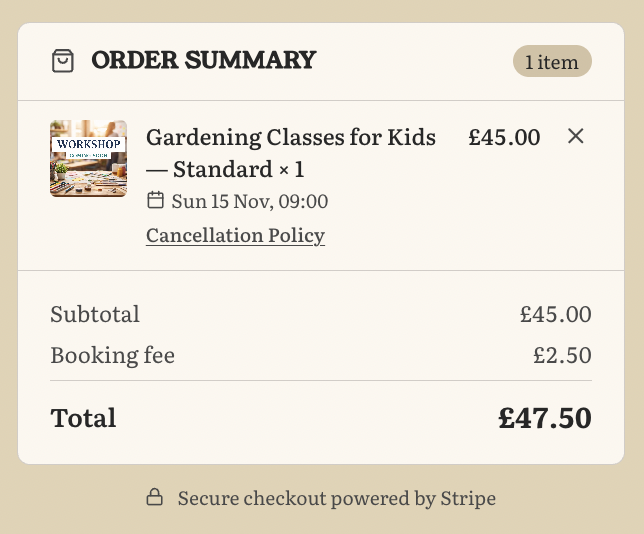
Charging customers a booking fee can help protect the amount you receive from each booking.
Advantages include:
- Protecting your margins. You don't have to absorb the entire cost associated with every online booking.
- Better visibility over costs. Booking-related costs can be separated from the underlying price of your service.
- More predictable margins as bookings grow. As your booking volume increases, you're not necessarily absorbing every additional booking cost yourself.
- Useful for lower-margin services. If margins are already tight, absorbing additional costs on every transaction may not be attractive.
There are disadvantages too.
- Customers pay slightly more. This can matter when customers are particularly price-sensitive.
- Unexpected fees can create friction. If customers only discover an additional charge late in the booking process, it may affect their experience.
- It adds another pricing decision. You need to decide how the fee should work and communicate it clearly.
Option 2: Absorb the Booking Fee Yourself
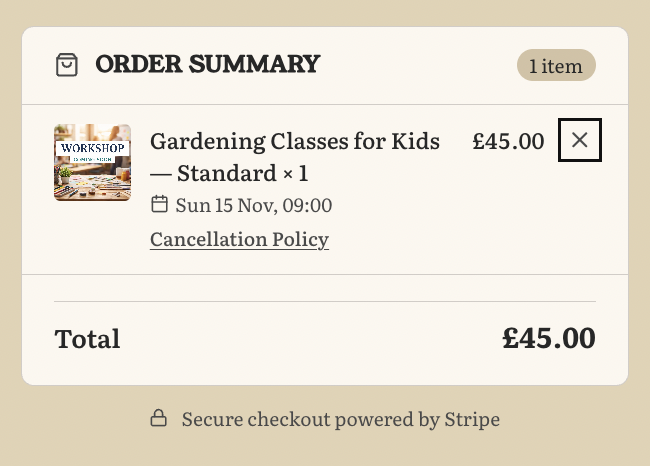
The alternative is to treat booking-related costs as another business expense and factor them into your overall pricing.
Advantages include:
- Simple customer-facing pricing. Customers see one price rather than a separate booking charge.
- A straightforward checkout experience. There are fewer individual charges for the customer to consider.
- You control the total advertised price. This may suit businesses that prefer an all-inclusive pricing model.
The downside is straightforward: your business pays those costs.
A small amount on one booking may not seem significant, but multiplied across a large number of transactions, it can become a meaningful expense.
What About Partially Covering the Cost?
It doesn't necessarily have to be an all-or-nothing decision.
Depending on your booking system, you may be able to set a booking fee that contributes towards your booking costs without necessarily trying to recover every penny.
For example, if your business incurs £1 in costs associated with a transaction, you might decide that absorbing 50p and charging the customer 50p provides a better balance for your pricing strategy.
The important part is understanding what your bookings actually cost and deciding how much of that cost you're comfortable absorbing.
Fixed vs Percentage Booking Fees
If you decide to charge a booking fee, one of the next questions is whether to use a fixed amount or a percentage.
Fixed Booking Fee
A fixed booking fee adds the same amount to each order.
For example:
Class price: £20
Booking fee: £0.50
Customer pays: £20.50
This can work well when most of your bookings are around a similar value.
Advantages:
- Simple to understand
- Predictable
- Easy to factor into your pricing
Potential disadvantage:
The same fee represents a much larger percentage of a small booking than a large one.
For example, a £1 fee represents 10% of a £10 booking but only 1% of a £100 booking.
Percentage Booking Fee
A percentage fee changes according to the value of the order.
For example, with a hypothetical 2% booking fee:
£10 booking → £0.20 fee
£50 booking → £1 fee
£200 booking → £4 fee
This can make sense for businesses with a wide range of booking values because the fee scales with the size of the transaction.
However, the amount customers pay also becomes larger on more expensive bookings.
How Much Should a Booking Fee Be?
There isn't one booking-fee percentage or fixed amount that's right for every business.
Rather than choosing an arbitrary figure, start by looking at:
- Your actual payment-processing costs
- Your booking-platform costs
- Your average booking value
- Your profit margin
- How frequently customers book
- Whether customers usually make one booking or purchase several items together
- How much of the cost you're comfortable absorbing
For example, a business selling £10 drop-in classes may approach booking fees differently from one selling £300 multi-week courses.
The goal isn't necessarily to recover as much as possible. It's to find an approach that makes financial sense for the business while keeping pricing clear for customers.
Booking Fee Examples
Here are a few simplified examples showing how different approaches can work.
These are illustrations rather than recommendations — your actual costs will depend on your payment provider, booking platform and pricing setup.
Example 1: £12 Drop-In Class
Suppose you charge £12 for a yoga class.
You could:
Absorb the costs: Customer pays £12.
Add a 2% booking fee: Customer pays £12.24.
Add a 50p fixed booking fee: Customer pays £12.50.
On relatively low-value bookings, even a small fixed fee represents a noticeable percentage of the overall price, so it's worth considering how customers may perceive it.
Example 2: £65 Workshop
For a £65 one-day workshop:
No separate fee: Customer pays £65.
1.5% booking fee: Customer pays £65.98 when rounded to the nearest penny.
£1 fixed booking fee: Customer pays £66.
At this price point, the difference between fixed and percentage pricing may be relatively small.
Example 3: £180 Six-Week Course
For a £180 course:
No separate fee: Customer pays £180.
1.5% booking fee: Customer pays £182.70.
£1 fixed booking fee: Customer pays £181.
Here, the difference between fixed and percentage fees becomes more noticeable.
Example 4: £240 Term Booking
For a £240 term:
No separate fee: Customer pays £240.
2% booking fee: Customer pays £244.80.
£1 fixed booking fee: Customer pays £241.
This demonstrates why businesses with both low- and high-value bookings should think carefully about whether a fixed or percentage fee better suits their pricing.
Should You Include Booking Costs in Your Prices Instead?
There's another option: factor your booking costs into your prices rather than displaying a separate fee.
For example, instead of:
Class: £20 + £0.50 booking fee
you might simply charge:
Class: £20.50
This gives customers one price to consider.
However, increasing your base price affects every booking, whereas a separate booking fee keeps the cost visible as part of the booking transaction.
Which approach is better depends on how you position your pricing and how much simplicity you want at checkout.
How to Decide What's Right for Your Business
Before changing your booking fees, ask yourself a few questions.
1. What does each booking actually cost me?
Look at payment processing, booking-platform costs and any other transaction-related expenses.
Understanding the real number gives you a much better starting point than choosing a random percentage.
2. What is my average booking value?
A fixed fee behaves very differently on a £10 booking than on a £200 booking.
If your prices vary significantly, a percentage-based approach may behave more consistently relative to the order value.
3. How strong are my margins?
If your margins are already tight, absorbing every booking-related cost may have a bigger impact on your business.
4. How frequently do customers book?
A customer purchasing a £10 class every week may experience a booking fee differently from someone purchasing one £200 course every few months.
5. How clear is my pricing?
Whatever approach you choose, customers should be able to understand what they're paying before completing their purchase.
Clear pricing creates a better experience than unexpected costs appearing at the end of checkout.
Booking Fees vs Card-Processing Fees: What's the Difference?
These terms can easily become confused.
A card-processing fee is a cost associated with processing the customer's card payment.
A booking fee is an amount charged to the customer as part of making their booking.
The two amounts don't necessarily have to be identical.
For example, a business may choose to absorb all its payment-processing costs and charge no separate booking fee. Another may use a booking fee to offset some of the costs associated with taking bookings online.
Understanding this distinction makes it easier to decide how you want to structure your pricing.
How Booking Fees Work With Baluu
Baluu is an online booking system for classes, courses, workshops, activities and experiences. It helps businesses take online bookings and payments while managing customers, availability and other parts of the booking process in one place.
With Baluu, you can choose who covers your booking costs.
You can either:
- Cover the costs yourself, so they're not passed on to the customer, or
- Pass a booking fee on to customers.
If you choose to pass the booking fee on, Baluu gives you two ways to set it:
Automatic Booking Fees
With the automatic option, Baluu calculates the booking fee based on your Baluu commission plus an estimated card-processing fee.
This removes the need to calculate the amount manually.
Manual Booking Fees
If you'd prefer more control, you can set the booking fee manually.
You can choose either:
- A percentage of each order, or
- A fixed amount per order
This allows businesses to choose the approach that best suits their pricing rather than being locked into one fee structure.
For step-by-step instructions, see Baluu's How to Set Up Booking Fees Help Centre guide.
Frequently Asked Questions
What is a booking fee?
A booking fee is an additional charge applied when a customer makes a booking. Businesses may use booking fees to offset some of the costs associated with accepting and managing online bookings.
Why do businesses charge booking fees?
Businesses may charge booking fees to help cover costs associated with online bookings, protect their margins or separate booking-related costs from the main price of their service.
Should I charge customers a booking fee?
It depends on your business. Consider your margins, average booking value, transaction costs and customer expectations. Some businesses prefer to absorb booking costs for simpler pricing, while others pass some or all of the cost on through a booking fee.
How much should a booking fee be?
There is no universal amount. Start by calculating your actual booking and payment-processing costs and then decide how much, if any, you want customers to cover.
Is a booking fee the same as a card-processing fee?
No. A card-processing fee is a cost associated with processing the customer's payment. A booking fee is a separate amount charged to the customer as part of their booking.
Is a fixed or percentage booking fee better?
A fixed fee can be simple and predictable, particularly when your bookings are similarly priced. A percentage fee scales with the value of the order and may be more suitable if your booking prices vary considerably.
Should booking fees be clearly displayed?
Clear pricing is important. Customers should be able to understand the total cost of their booking before completing their purchase. Businesses should also make sure their pricing practices comply with the consumer and payment rules that apply in their market.
Can I change my booking fee later?
That depends on the booking system you use. With Baluu, businesses can adjust their booking-fee settings if they decide a different approach works better for them.
So, Should You Charge a Booking Fee?
There isn't a universal answer.
If margins are tight and transaction costs represent a meaningful expense, passing on a booking fee may make sense. If simple, all-inclusive pricing is more important to your business, you may prefer to absorb those costs instead.
You can also choose an approach somewhere between the two.
What matters is understanding the cost of taking bookings, deciding how much you're comfortable absorbing and keeping your pricing clear for customers.
With Baluu, businesses can choose whether to cover booking costs themselves or pass a booking fee on to customers, with automatic and manual options available.
If you're already using Baluu and want to configure your fees, follow the How to Set Up Booking Fees guide for step-by-step instructions.
Written by
Ruta Jogminaite
Expert in booking systems and appointment-based business optimization.
More to explore
Continue Reading

How to Get More Bookings for Your Classes: 12 Proven Ways
Struggling to fill your classes? Discover 12 practical ways to attract new customers, increase bookings, fill empty spaces and turn first-time visitors into regulars.

AI Booking Software With Human Support: Why Baluu Gives You Both
Discover how Baluu combines AI booking software with real human support, helping small businesses manage classes, courses, events and appointments without being left to figure everything out alone.

Why Choose Baluu? Flexible Booking Software With Real Human Support
Discover why Baluu is a flexible online booking system for classes, courses, appointments and events, with powerful booking tools, flexible pricing and real human support to help you get set up and start taking bookings.