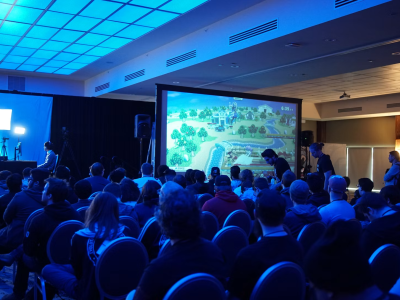
For decades, corporate events followed a familiar script: a venue, a stage, a schedule of speakers, and rows of attendees sitting quietly through sessions they'd forget by Monday morning. That format is now losing ground to something fundamentally different.
The rise of experiential events reflects a measurable shift in what organizations expect from gatherings. Immersive experiences outperform traditional formats on audience engagement, memory retention, and emotional connection, which are outcomes that matter to business leaders, not just event planners.
Changing attendee expectations have accelerated this shift, alongside advances in event technology and the growing role of social sharing in extending an event's reach beyond the room. Companies are increasingly treating corporate events as strategic investments, which means passive attendance is harder to justify when participation-driven formats consistently deliver stronger results.
Why Experience-Led Events Are Gaining Ground
The core reason for this shift is straightforward: traditional corporate events often rely on passive attendance, while experience-led formats ask people to participate. That distinction has real consequences for what an event actually produces.
According to experiential event statistics, immersive experiences consistently outperform conventional formats on audience engagement, memory retention, and emotional connection. Organizations are responding to those numbers because the business case is clear. Beyond the data, the shift is also being driven by changing attendee expectations, the rapid evolution of event technology, and the growing importance of social sharing as a measure of reach and relevance. Taken together, these forces are pushing companies to treat corporate events not as logistical obligations, but as strategic tools designed around measurable outcomes.
What Traditional Gatherings No Longer Deliver
Most traditional corporate events are built around logistics: fill the agenda, secure the venue, load the slides, and move attendees from session to session on schedule. Attendee participation rarely factors into the design beyond applause and a post-event survey.
That structure can produce an impressive day without producing much else. A well-produced conference can draw attention, generate positive reactions in the moment, and then fade almost entirely from memory once attendees return to their desks.
Spectacle Draws Attention but Experience Drives Recall
The distinction here matters. A spectacle-first corporate event is designed to impress observers. An experience-led one is designed to involve participants, and that difference has a direct effect on brand engagement and brand perception.
When attendees move through something rather than simply watch it, brand storytelling lands differently. The narrative becomes something they lived, not something they heard. That shift in how information is processed is precisely why interactive experiences tend to generate stronger associations with a brand long after the event ends.
Traditional formats were never built for that outcome, and that gap is exactly what is driving the replacement now.
Why Attendees Now Expect More Than a Program
Source
The shift away from traditional corporate gatherings is not only a supply-side change driven by planners and event designers. It is equally demand-led, shaped by audiences who have grown accustomed to relevance, choice, and active involvement in almost every other part of their professional lives. As those expectations have risen, so too has the complexity of delivering on them, which is why corporate events management now requires a far more integrated approach to strategy, logistics, and participation design than it once did.
Personalization and Participation Now Shape Value
Attendees no longer measure an event's worth by the quality of the catering or the prominence of the venue. They measure it by how much it felt relevant to them specifically, and whether they played any role in shaping the experience.
That expectation has real consequences for format. One-way communication, where a speaker talks and an audience absorbs, struggles to meet that standard. Interactive experiences create emotional connection because the attendee becomes part of the moment rather than a passive observer of it.
Event technology has made it practical to deliver this at scale. From real-time polling and personalized agendas to post-event data collection, organizers can now build private corporate event experiences around individual preferences rather than assumed ones.
Social Sharing Extends the Event Beyond the Room
There is also a visibility dimension that traditional formats rarely account for. Participatory events generate content, conversation, and social media amplification in ways that passive ones simply do not.
When attendees share moments from an event, they extend its reach well beyond the room. That organic visibility matters to organizations weighing the return on their investment, and it consistently favors formats that are memorable, visual, and designed for audience engagement.
How Experience-Led Events Create Business Value
The business case for experience-led events connects directly to the participation gap described in the previous sections. When attendees are actively involved, the outcomes tend to be measurably different from those produced by conventional formats.
Better Engagement Leads to Better Outcomes
Formats that involve participants rather than simply observe them tend to produce stronger brand engagement, more favorable brand perception, and significantly better memory retention. Attendees who move through a designed experience carry a different kind of association with the brand than those who sat through a presentation.
That difference shows up in outcomes that matter to decision-makers: stronger client relationships, measurable gains in team cohesion, higher-quality leads, and a greater likelihood of meaningful action following the event. These are not soft benefits. They are the outcomes organizations track when evaluating whether a gathering earned its budget.
ROI Is Measured Beyond Turnout and Applause
Attendance numbers have never been a reliable indicator of business value, yet they remain the default metric for many organizations. Experience-led formats require a broader measurement framework.
Useful indicators include participation depth, post-event sentiment, content sharing, qualified follow-up conversations, and recall tested days or weeks later. The experiential event statistics emerging from this space consistently show that immersive formats outperform traditional ones against these wider measures.
That is why organizations continue investing. Much like selling experience-based gifts, the value lies in what the experience produces, not simply in delivering it.
Why the Shift Is Not Risk-Free for Organizers
Moving toward experiential events is not simply a matter of choosing a more engaging format. It introduces genuine operational complexity that organizations need to account for before committing to the approach.
Experience-led corporate events typically require tighter cross-functional coordination, more detailed production planning, and a higher tolerance for moving parts. Personalization, event technology, and production quality each carry their own cost and logistical demands, and expecting all three at once can stretch budgets quickly.
There is also a strategic risk worth naming. When the concept is immersive but disconnected from clear business goals, the result can be an expensive and memorable day that produces little of measurable value. Spectacle without purpose does not improve ROI; it just makes the gap harder to explain afterward.
The broader point is not that traditional formats are disappearing entirely. Organizations are simply becoming more deliberate about which format fits which objective, and that selectivity is what separates events that earn their investment from those that do not.
What This Shift Means for Future Event Planning
Experience-led formats are steadily replacing many traditional corporate gatherings because they align more directly with how audiences behave and what organizations actually need to demonstrate from their investment.
The strongest corporate events are now built backward from the outcome. Planners choose the format that best supports participation, meaning, and measurable impact, rather than defaulting to familiar structures that prioritize logistics over experience.
The market is moving in one clear direction. Immersive experiences and intentional audience engagement are producing the kind of results that organizations can defend, track, and build on. Corporate events that people actively remember, share, and respond to are no longer the exception. They are becoming the standard.
Written by
Ruta Jogminaite
Expert in booking systems and appointment-based business optimization.
More to explore
Continue Reading

Why Community Clubs Are Becoming One of the Most Meaningful Businesses to Start Right Now With Baluu Custom Booking Software
Discover why community clubs, social meetups, and wellness groups are becoming one of the fastest-growing business ideas in the UK. Learn how organizers are building meaningful offline communities through walks, hobby groups, coffee meetups, and local events — and how Baluu helps manage bookings, memberships, reminders, and recurring community experiences in one place.
Why Women’s Run Clubs and Social Running Communities Are Growing So Fast
Organize run clubs, social walks, and community fitness events with Baluu. Create free or paid events, manage bookings, send reminders, organize memberships, and keep your running community connected in one place.

If You Run a Pottery Studio, You Need This Sooner Than You Think
Discover the hidden operational challenges most pottery studios face as they grow. From recurring classes and cancellations to memberships, customer communication, and scheduling chaos, this article explores why many pottery studios eventually outgrow spreadsheets and manual systems — and how platforms like Baluu help studios manage bookings, workshops, memberships, reminders, and customer experiences more efficiently.