
If you run a class-based business — an art school, music studio, fitness programme, language school or creative workshop — selling a multi-week course is different from selling a single class.
You're not simply selling one date. You're selling a structured programme made up of several sessions, with a defined schedule, limited places and a price that needs to make sense for the whole course.
Trying to manage this through emails, spreadsheets or individual messages can quickly become difficult.
This guide shows you how to set up and sell a multi-week course online with Baluu, using one example business throughout so you can follow the process and adapt it to your own course.
Our example
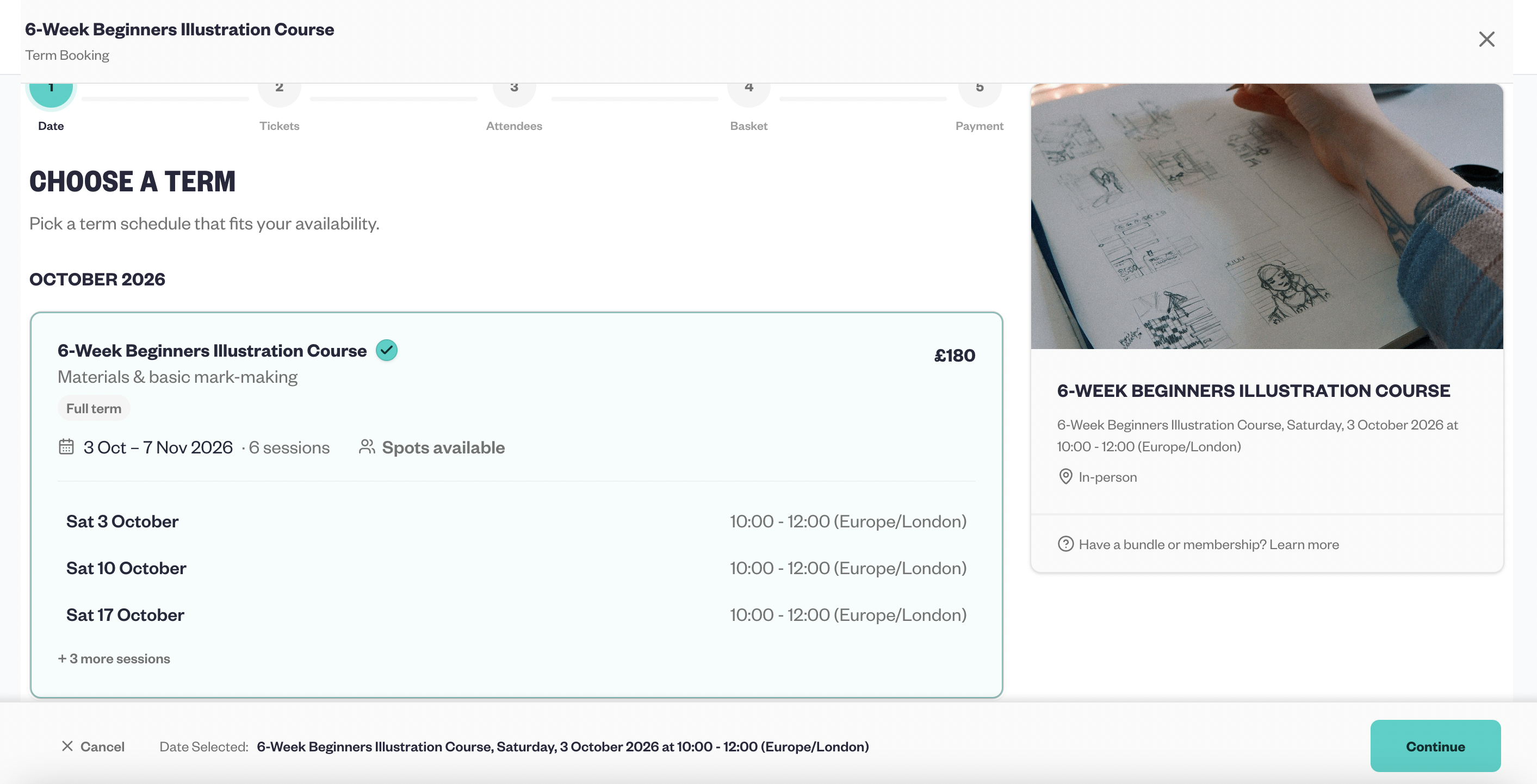
Thistle & Ink Art School is launching a six-week beginner illustration course.
The course runs every Saturday morning, has a maximum of 12 students and costs £180 for the complete six-week programme.
Let's set it up.
Step 1: Plan Your Course Before Setting It Up
Before opening your booking software, decide exactly what you're selling.
For Thistle & Ink, that means:
- Course: 6-Week Beginners Illustration Course
- Number of sessions: 6
- Day: Saturday
- Time: 10:00am–12:00pm
- Capacity: 12 students
- Price: £180
- Format: In-person
- Start date: 4 October
- End date: 8 November
The school also plans the content of each session:
Week | Date | Topic |
|---|---|---|
1 | 3 Oct | Materials & basic mark-making |
2 | 10 Oct | Line and form |
3 | 17 Oct | Working with ink washes |
4 | 24 Oct | Colour theory basics |
5 | 31 Oct | Composition |
6 | 7 Nov | Final piece & showcase |
Having this information ready makes the actual setup much easier.
Step 2: Choose the Right Listing Type
Baluu offers different listing types depending on how you want customers to book.
- Regular — useful for recurring sessions where customers can book individual dates.
- Event — useful for one-off events and workshops.
- Appointment — useful when customers choose an available time for a service.
- Termly — useful for structured programmes running over a defined period.
For Thistle & Ink, the six-week illustration programme is structured around a defined course with a set start and end date, so they choose Termly.
If you're running ongoing weekly classes, one-off workshops or one-to-one sessions instead, another listing type may be more appropriate.
Step 3: Ask Students the Right Questions
A multi-week course gives you an opportunity to learn a little about your students before they arrive for the first session.
Instead of sending a separate email asking everyone about their experience, Thistle & Ink can collect useful information during the booking process.
For example, they could ask:
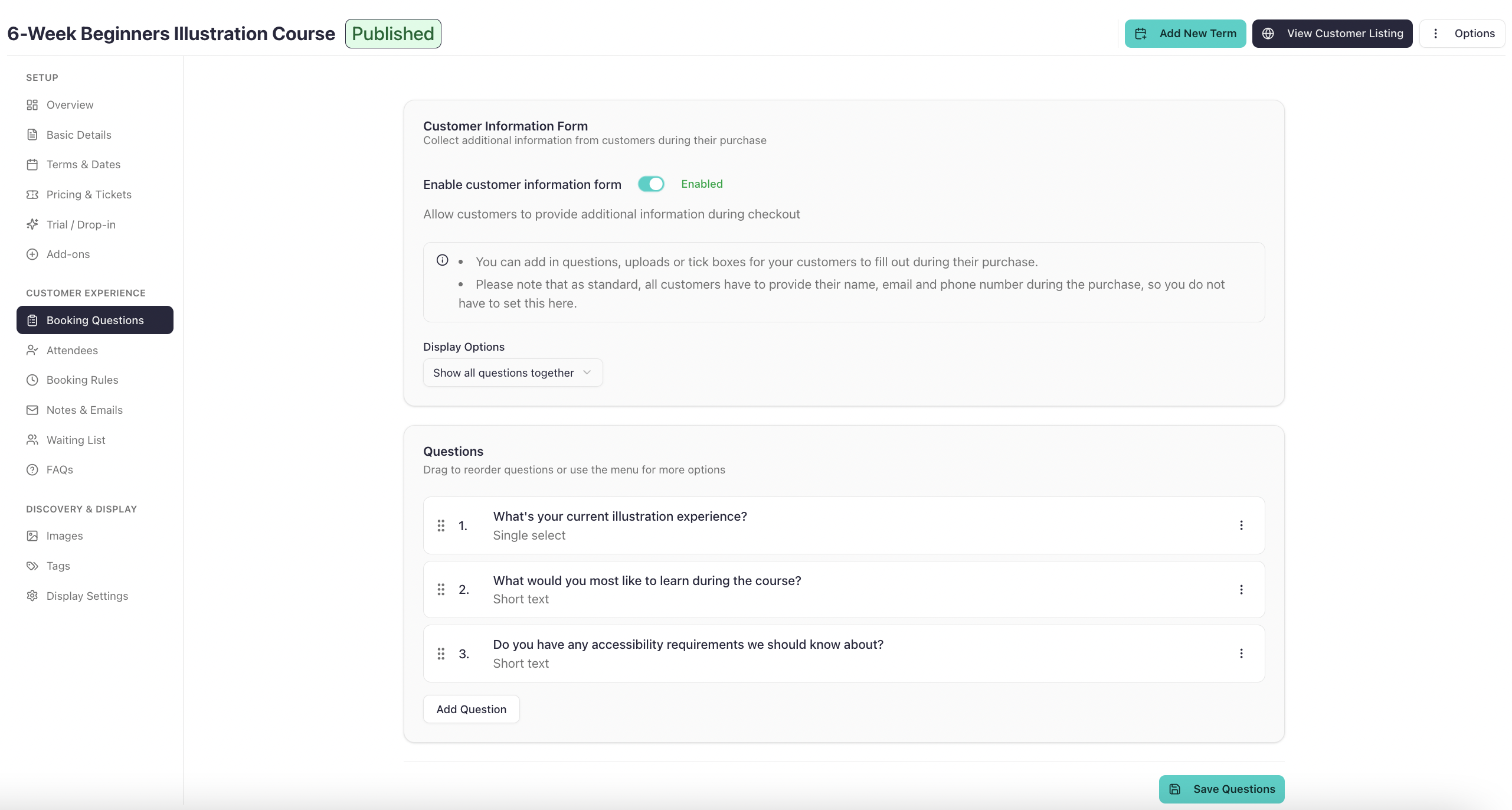
What's your current illustration experience?
- Complete beginner
- Some previous experience
- Experienced
What would you most like to learn during the course?
This could be a free-text question where students explain what they want to improve.
They could also ask:
Do you have any accessibility requirements we should know about?
The key is not to ask everything you possibly can. Only ask questions that will actually help the tutor prepare for the course.
Baluu's Booking Questions feature allows businesses to collect additional information from customers during the booking process.
See Baluu's Booking Questions guide
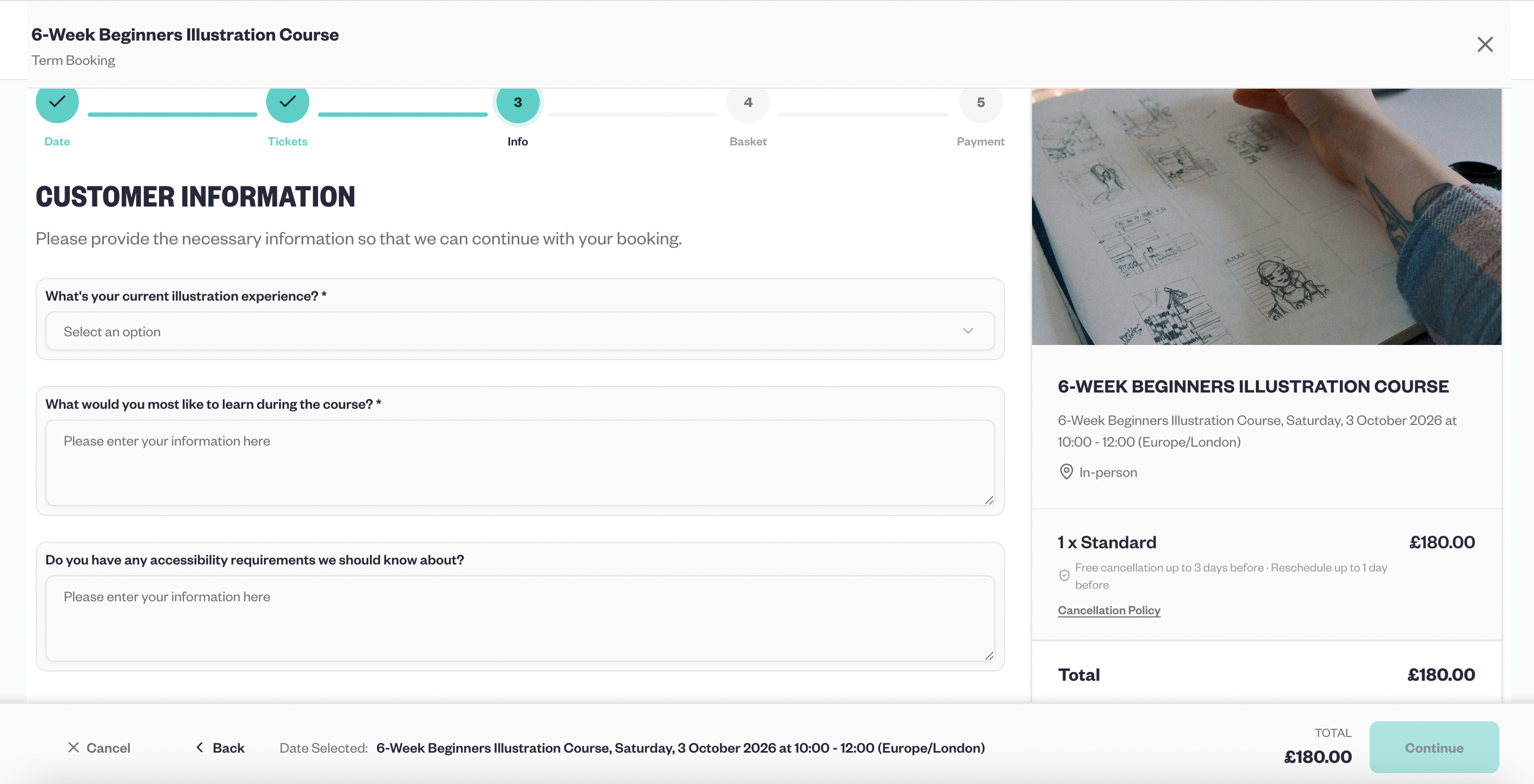
For Thistle & Ink, the tutor could then review the answers before the first Saturday and have a much better idea of who is joining the class.
Step 4: Decide When Bookings Should Close
You don't necessarily want customers booking five minutes before a class starts.
A multi-week course may need preparation beforehand — especially if you're ordering materials, preparing workstations or checking the number of students attending.
This is where a Booking Cutoff can be useful.
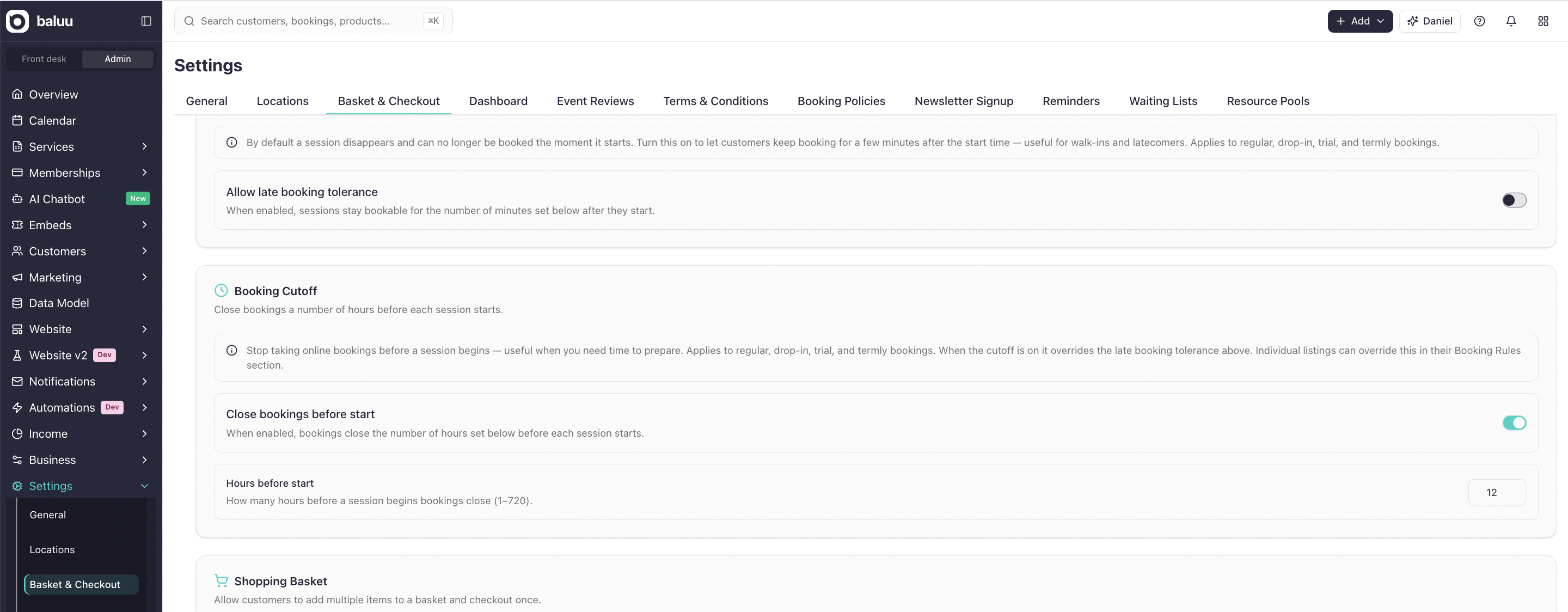
For example, Thistle & Ink could decide that online bookings should close 12 hours before a session begins.
That gives the tutor time to prepare without having to monitor bookings right up until the start of class.
In the Booking Rules, the business can set how many hours before a session bookings should close. The available range is 1–720 hours.
For example:
Booking cutoff: 12 hours before the session
So if Saturday's class begins at 10am, online bookings would close at 10pm on Friday.
This is a small setting, but it can make a difference when you're running a course where preparation matters.
Step 5: Set Clear Booking Policies Before Students Enrol
When someone commits to six weeks, it's important that they understand the terms of the course before paying.
Thistle & Ink might want to clearly explain:
- The six course dates
- The session length
- What is included
- What students need to bring
- The location
- Whether materials are included
- What happens if a student cannot attend
- The relevant cancellation or booking conditions
This is where clear booking policies can help.
Rather than putting important rules somewhere customers are unlikely to find them, make the conditions part of the booking experience.
For example, Thistle & Ink could have a policy covering cancellations and changes to bookings.
See how to add Booking Policies in Baluu
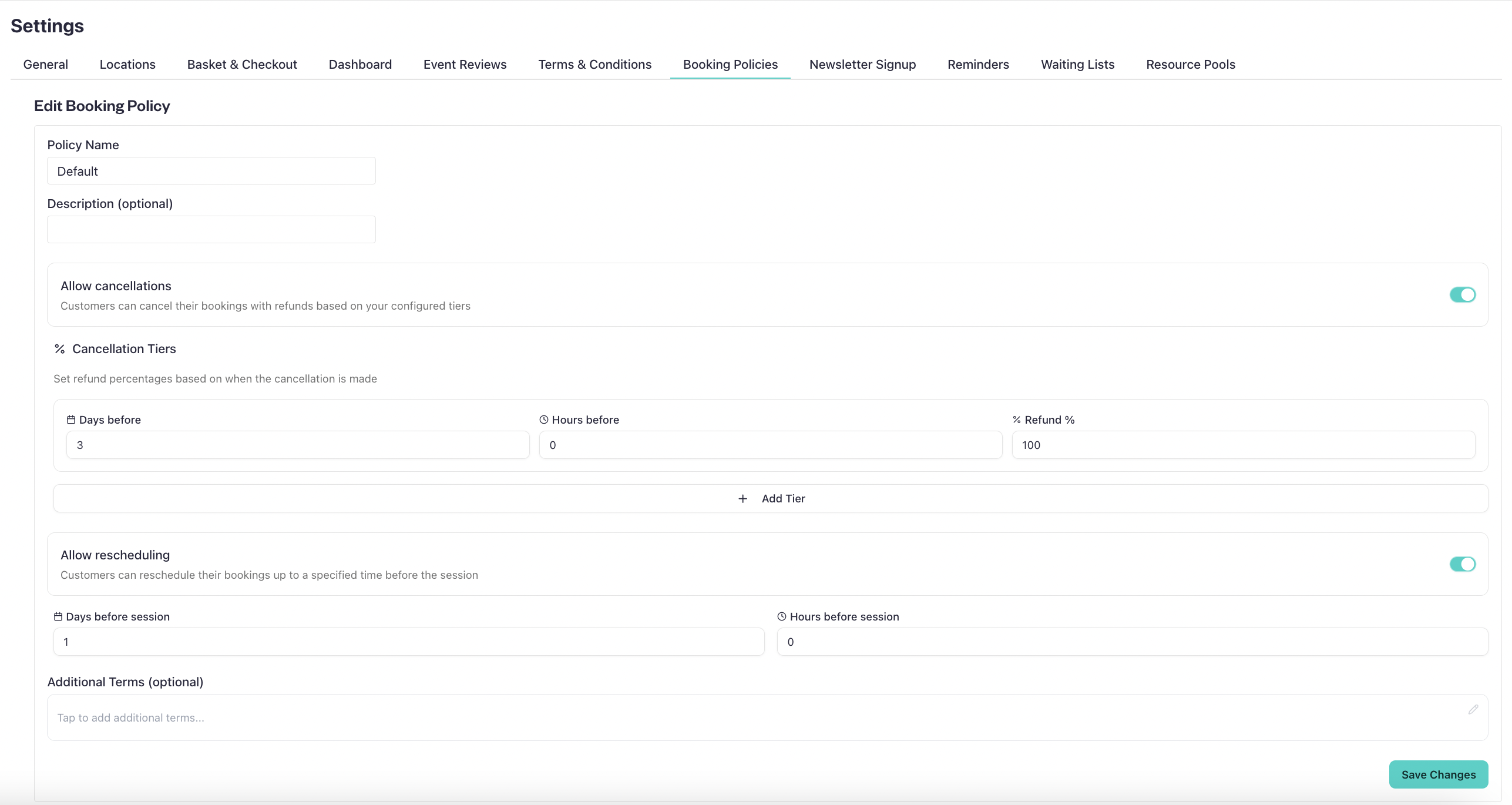
The exact policy will depend on the business, but the principle is simple: make the expectations clear before the customer commits.
Step 6: Keep Students Engaged After They Book
Getting someone to book is only the beginning.
For a six-week programme, you have six weeks of customer communication to manage.
Thistle & Ink might want to remind students about:
- The first session
- What to bring
- A change to the studio entrance
- Upcoming course dates
- Materials for a particular session
- The final showcase
This is where having your customer list organised becomes useful.
Instead of individually messaging everyone who has attended the course, you can use your customer information to communicate with your audience more efficiently.
Baluu also provides a newsletter feature that can be used for communicating with customers and promoting upcoming offerings.
See how to create and send newsletters in Baluu
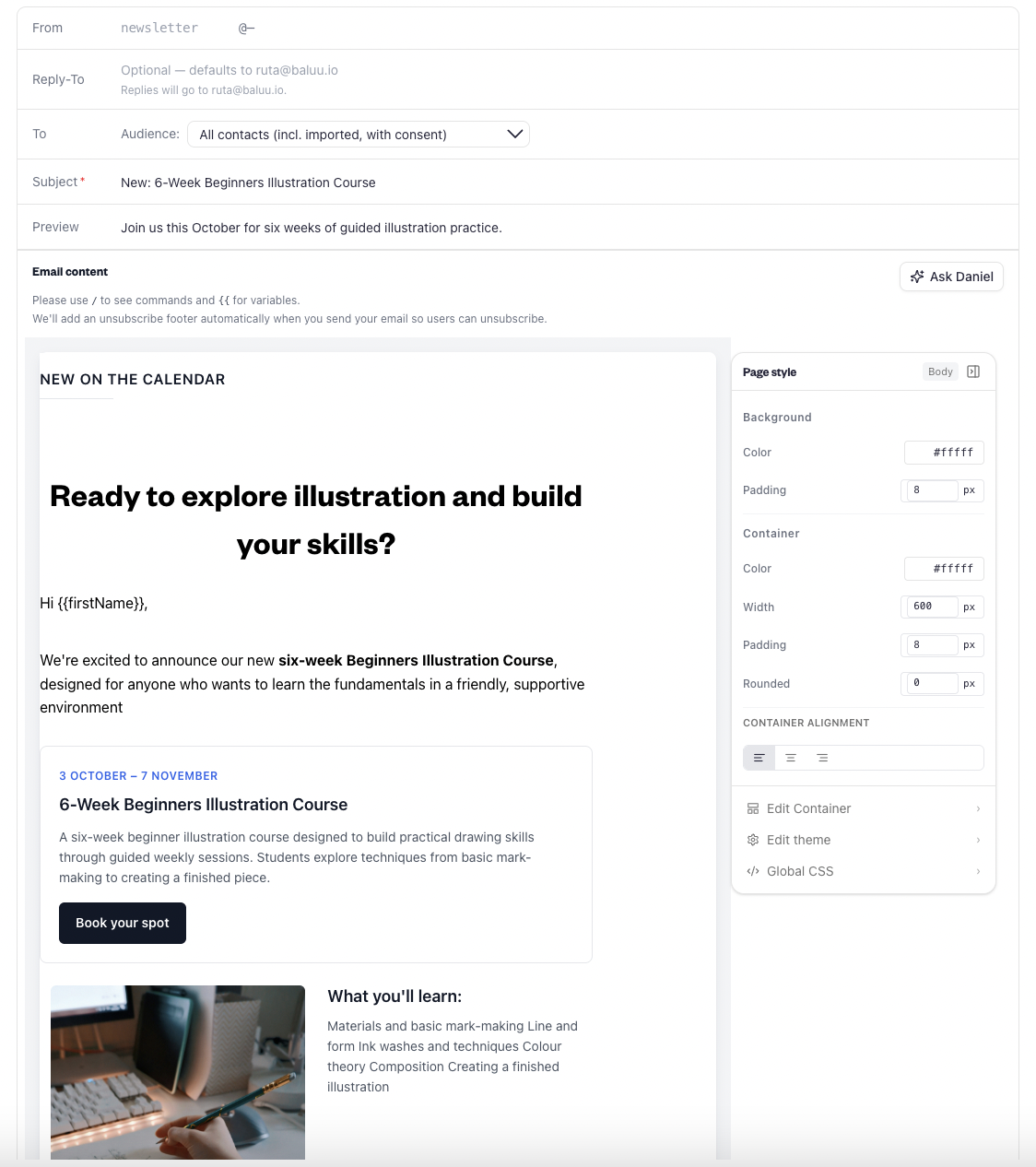
For example:
New October Illustration Course
Our next six-week beginner course starts in January. Places are limited — join us for six Saturday mornings of drawing, ink techniques and guided projects.
That turns the first course into an opportunity to fill the next one.
Step 7: Ask Students What They Thought
A multi-week course gives you something a one-off event doesn't: a lot more opportunity to learn from your customers.
At the end of the course, Thistle & Ink could ask students what they thought about:
- The course content
- The length of the sessions
- The difficulty level
- The tutor
- The studio
- What they would like to learn next
Baluu supports reviews and post-event emails, which can help you collect feedback after an event or course.
See Baluu's guide to Reviews and Post-Event Emails
The feedback can then help answer a much more useful question than simply “Did people book?”
Would people book this course again — and what would make the next version better?
Step 8: Use What You Learn to Plan the Next Course
Now Thistle & Ink has completed its first six-week programme.
Instead of starting from zero, the owner can look at what happened.
For example:
Course: 6-Week Beginners Illustration
Places: 12
Price: £180
Revenue if full: £2,160
Then consider:
- Did all 12 places sell?
- How quickly did bookings come in?
- Which questions did students ask before booking?
- Did the course length feel right?
- Was the Saturday morning time popular?
- What did students want to learn next?
- Did students leave positive reviews?
- Should the next course have the same price?
This turns one course into a repeatable product.
The next six-week course doesn't need to be reinvented. You already know what worked, what didn't and what your customers want.
A Simple Multi-Week Course Setup
For our example, Thistle & Ink ends up with something like this:
Course detail | Example |
|---|---|
Course | 6-Week Beginners Illustration |
Listing type | Termly |
Sessions | 6 |
Day | Saturday |
Time | 10am–12pm |
Capacity | 12 |
Price | £180 |
Booking questions | Experience, goals, accessibility |
Booking cutoff | 12 hours |
Policies | Cancellation/booking terms |
Promotion | Website, Instagram, newsletter |
After course | Reviews + feedback |
Next step | Promote the next course |
Together, these settings help you manage more than the initial booking — from collecting information before the course to communicating with students and gathering feedback afterwards.
Ready to Sell Your Multi-Week Course Online?
A successful multi-week course isn't just about putting six dates on a calendar.
It's about making the commitment clear, collecting the information you need, setting expectations before students book and continuing the relationship after the payment is made.
With Baluu, you can bring those parts of the customer journey together while keeping the course itself organised in one place.
Ready to build your first course?
Start for free with Baluu
Set up your course, add your sessions and create a booking experience your students can use online.
Written by
Ruta Jogminaite
Expert in booking systems and appointment-based business optimization.
More to explore
Continue Reading

How to Get Your Business Found in ChatGPT and AI Search?
Learn how to improve your business’s visibility in ChatGPT and AI search with clear website content, SEO, reviews and accurate business information.

What Information Should I Ask Customers for When They Book Online?
Learn what information to collect during online booking, from customer and attendee details to custom questions, allergies and marketing consent — without making your checkout unnecessarily complicated.

How Can I Reduce Booking Calls and Messages Without Hiring More Staff?
Learn how to reduce booking calls, messages and front-desk admin using online self-service, automation and AI booking assistants like Baluu’s Junno — without losing the personal touch.